
SHORT TERM SCHEMES
YUVASENE CLASS
MID TERM SCHEMES
SALARY CLASS
LONG TERM SCHEMES
BUSINESS CLASS
Easy documentation for quick processing.
Checklist of Documents.
You need to submit the following documents to Yuvanadu Chits Company for the Application Form for Enrolment & Register of Chits and participate in a Yuvanadu Chits Group.
During enrolment, you need to submit self-attested copies of the following documents.
At the time of Prize Money enrolment processing, the subscriber must submit self-attested copies of the following documents along with the required application forms.
KYC Documents
| Mandatory with all classes of Security from both Subscriber/s & Guarantors | |
|---|---|
| Identity/Age Proof | Copy of Aadhaar Card / Voter ID / PAN Card / Passport (Self attested) |
| Address Proof | Copy of Aadhaar Card / Voter ID / Passport / Gas Bill / Electricity Bill / Mobile Bill (Self Attested) |
| Permanent Address Proof | Copy of Aadhaar Card / Voter ID / Passport / Gas Bill / Electricity Bill / House Tax receipt (Self-attested) |
| *# Copy of House / Property | Latest tax paid receipt |
Income Documents
| For Employees | For Businesspersons / Professionals / Others |
|---|---|
| Copy of Employee ID Card | Copy of GST Certificate / Licenses / Govt approvals |
| Computerized Payslip / Salary Certificate (self-attested) / with disbursing officer attestation for latest three months | Copy of Proof of business established for ten years |
| Copy of Bank Account statement for latest one year (self-attested) – salary account | Copy of Bank Account statement for latest one year (Self-attested) – business account |
| Copy of Form No. 16 issued by Employer (for latest three years) | Copy of Audited Balance Sheet / Profit & Loss Account / adjusted statement of income certified by an auditor, GST Returns for latest three years |
| Copy of Income Tax Return for latest three years with Acknowledgment/income computation (Self-attested) |
A chit fund is a type of savings and credit scheme where a group of people contribute a fixed amount of money regularly for a specific period. The collected money is then distributed among the members in a systematic way.
Let's say chit fund scheme with 50 members that will run for 50 months, with each paying a monthly subscription of ₹10,000/- to create a ₹5,00,000/- pot. When the auction is announced, the member who bids the highest discount wins the Bid. (30% is the maximum discount anyone can bid as per Law).
| Number of member's in the chit fund scheme | 50 Members |
| Duration | 50 months |
| Monthly subscription payable by each member | Rs. 10,000/- |
| Total Chit value | Rs. 5,00,000/- (50 member's x 10,000) |
In this example, let us assume the winning bid offered a 30% discount.
| Discount offered by the winning bid | 30% |
| Amount of discount | Rs.1,50,000/- (30% of 5,00,000) |
| Amount received by the winner | Rs.3,50,000/- (5,00,000 less 1,50,000) |
The balance amount is distributed equally among the member's after deducting the Foreman’s commission.
| Foreman’s commission | 5% = Rs.25,000/- |
| Total Dividend | Rs.1,50,000/- less Rs.25,000 = Rs.1,25,000/- |
| Dividend credited to each member’s account | Rs.1,25,000/50 = Rs.2,500/- |
Next month: The process repeats with a new auction and winner.
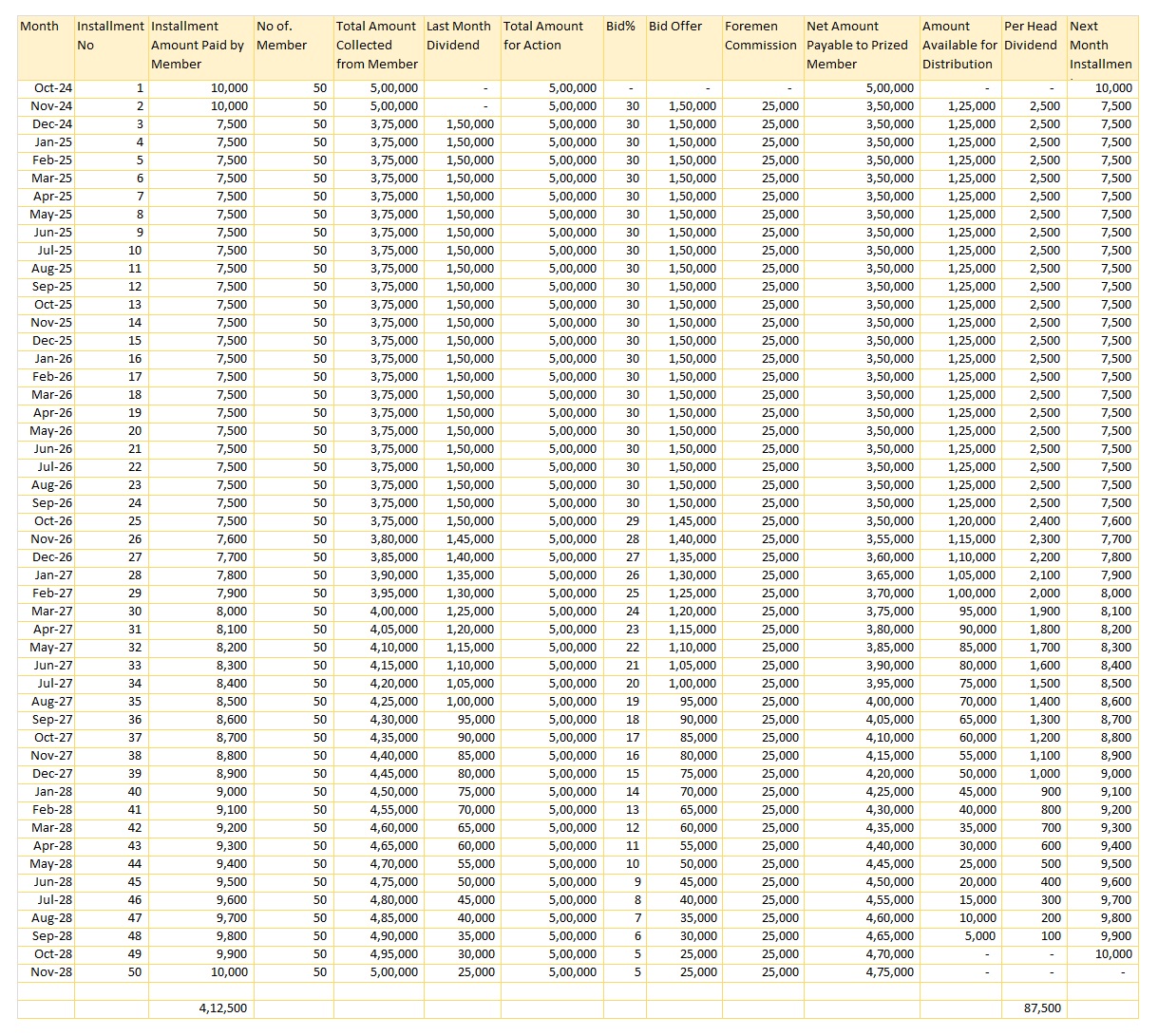
| 3,50,000 | Total Amount Received - ₹3,50,000 (₹5 Lakhs) | ||||
| 7,500 | (18% of FC as GST & Document Charges) | ||||
| 3,42,500 | Net Amount Payable to Prized Member | ||||
| 4,12,500 | Invested Amount by Member | ||||
| -70,000 | Loss | ||||
| Invested 4,12,500 |
Dividend 87,500 |
Loss -70,000 |
Total 4,30,000 |
Invested 4,12,500 |
Net Profit 17,500 |
or
| 4,75,000 | Total Amount Received - ₹4,75,000 (₹5 Lakhs) | ||||
| 7,500 | (18% of FC as GST & Document Charges) | ||||
| 4,67,500 | Net Amount Payable to Prized Member | ||||
| 4,12,500 | Invested Amount by Member | ||||
| 55,000 | Profit | ||||
| Invested 4,12,500 |
Dividend 87,500 |
Profit 55,000 |
Total 5,55,000 |
Invested 4,12,500 |
Net Profit 1,42,500 |
A member can participate in the auction for the Prize Money from the second month onwards. The first month's Gross Chit Amount goes to the company. To be eligible to make a bid, the subscriber should have paid all the instalments and not have any pending ones.
A subscriber can participate in the auction in the following ways:
1. Direct Participation:
The member can either participate online or personally attend the auction in the
Chit office on the date and time specified in the Chit Fund agreement.
2. Bid Offer Letter:
The subscriber needs to fill in all the details in the letter before signing and sending it to the Chit's office.
3. Bid Authorization Letter:
The customer can send a proxy to participate in the auction on their behalf. The proxy must carry the
authorization letter & valid ID proof to participate in the auction.